Wind energy
-
Wind turbines operate for up to 95% of the time, but they do occasionally stop. This is usually for maintenance, to limit potential nuisance (such as noise, shadow flicker, or impacts on birds or bats), during work on the electricity grid, when there is no wind at all, or, unfortunately, during periods of negative electricity prices.
-
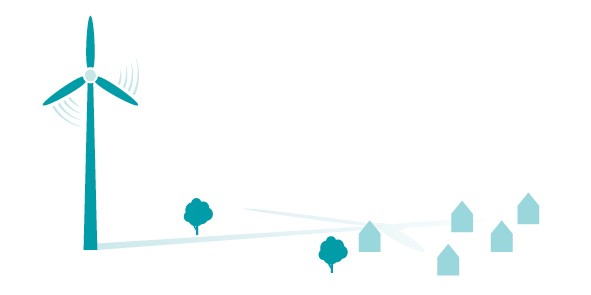
Shadow flicker is an effect of wind turbines that is limited and fully controllable. In Flanders for example, no residential property may experience more than 8 hours of shadow flicker per year, with a maximum of 30 minutes per day. For businesses, the limit is 30 hours per year.
Did you know… wind turbines know when it’s cloudy or sunny?
Wind turbines are equipped with light‑intensity sensors and smart control systems that allow them to detect when direct sunlight is present and whether shadow flicker could affect nearby homes.- where the sun is positioned;
- how intense the sunlight is;
- exactly when shadow flicker could reach a dwelling.
When necessary, they automatically shut down to prevent exceeding the permitted limits.
-
Noise standards are determined at national level and therefore differ from country to country.
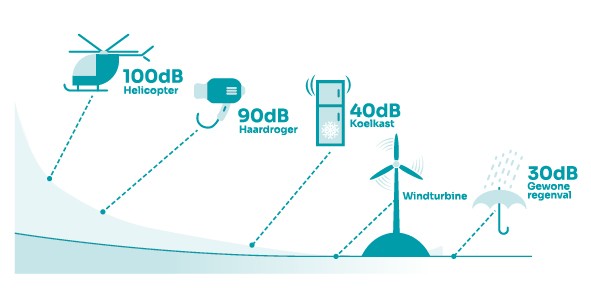
In Flanders, wind turbines must comply with strict maximum noise limits set out in the regulations. These limits vary depending on the time of day (day/evening/night) and the designated land‑use area.
In residential areas, the night‑time limit is 39 dB(A), while a maximum of 44 dB(A) is permitted during the day. Within 500 metres of industrial zones, the limits are 48 dB(A) during the day and 43 dB(A) at night.
-
The main risk bats face is not so much being struck by a wind turbine, although that can happen, but rather the strong pressure differences they experience when flying close to the rotating blades.
To limit this effect, extensive studies are carried out to assess all potential impacts of a project, both positive and negative. The aim is to avoid, reduce, or compensate for any negative effects as much as possible.
If research shows that bats are at risk during certain periods of the year or at specific times of day, depending on their biological rhythm, we are required to take mitigation measures. This includes curtailing turbine operation during those time windows in order not to disturb the species.
In addition, complementary measures are implemented around the project, such as planting hedgerows. These measures are designed to create bat‑friendly zones at a sufficient distance from the wind turbines.
-
Wind turbines have never been shown to be harmful to human health. However, by repeatedly claiming otherwise, lobbies opposed to wind energy and the energy transition sometimes succeed in creating fear among the public. The spread of unscientific and incorrect information through certain media outlets, social networks, anti‑wind energy groups, and climate change deniers lends credibility to unfounded rumours. This can lead to unnecessary concern, irritation, dissatisfaction, and social unrest.
What about noise, shadow flicker, and soil contamination?
Read more about these topics here in this infographic. -
Property values depend on a wide range of factors, including:
- economic activity in the area;
- local employment opportunities;
- the national economic cycle;
- the overall condition of the housing market;
- existing property values and their evolution;
- the location of the property within the municipality, and many other factors.
To date, no study has demonstrated a link between the presence of a wind farm and changes in property values. Fluctuations in real‑estate prices are primarily driven by market dynamics and by the services available in an area, such as transport, schools, waste collection, and other public facilities.
The installation of a wind farm therefore does not affect the objective valuation of a property. It may, however, influence subjective perceptions, which can differ from one person to another—some people appreciate wind turbines, others do not.
In addition, certain effects associated with the development of a wind farm can generate added dynamism within a municipality. This can indirectly increase property values through improvements to local services and facilities. In some municipalities, for example, residential taxes have been abolished and the number of building permits has increased following the development of a wind farm.
-
Wind turbines are designed to produce energy for at least 25-30 years, and this service life can often be extended. At the end of its lifespan, a wind turbine is dismantled and the site is restored to its original condition.
A wind turbine can be largely recycled: the steel, electronic components, and the concrete from the foundations can all be reused. Even the blades can be recycled. They are usually made from composite materials that can be repurposed as raw material, for example in the cement industry. Wind turbine blades can also be given a second life in more creative applications, such as bicycle shelters, playground equipment, or other structures.
Find more information here in this infographic.
-
The development of a wind farm is a multi‑step process, involving research, consultation, and coordination long before the first turbine becomes visible. On average, around eight years pass between the initial studies and the actual construction of a wind farm, although this timeline can vary significantly from one project to another.
Every wind farm therefore tells its own story, with a pace shaped by the local environment, applicable regulations, and the people involved.
You can find the different phases in this infographic.
-
Wind turbine lights are required by law for aviation safety. They help pilots detect and avoid obstacles and are regulated in most countries. While the exact rules vary by country and region, they are based on international aviation standards and adapted to local conditions.
In some countries, wind turbines are lit continuously. In others, only certain turbines—such as those on the edge of a wind farm—require lighting. Modern lighting systems use energy‑efficient LED lights that are designed to minimise light spill towards homes.
In Flanders, turbine lighting is strictly regulated through the environmental permit and follows international aviation guidelines. Depending on the height and location of the turbines, lighting may be required on the nacelle or tower, usually as red lights at night and, in some cases, white flashing lights during the day.
To reduce disturbance for nearby residents, smart lighting systems can be used where possible. These systems activate the lights only when an aircraft is nearby. This ensures a careful balance between air safety and quality of life on the ground.
Offshore wind energy
-
Bottom‑fixed offshore wind is used in shallow to medium‑depth waters (typically up to around 50–60 metres). The North Sea is a well‑known example where this technology is widely applied.
- Bottom‑fixed: turbines are fixed directly to the seabed.
- Floating: turbines float on the water surface and are anchored with cables or chains.
Many areas with strong and consistent winds are located in deep offshore waters, for example off the coasts of Scotland, France, and Japan. Floating wind technology makes these locations accessible, significantly expanding the potential for offshore wind energy production.
-
The platforms use smart designs (such as spar, semi‑submersible, or tension‑leg platforms), combined with mooring lines anchored to the seabed. This keeps the turbine stable, even in strong waves and high winds. For more information on how this technology works, visit our project websites:
- Pennavel (FR)
- Buchan Offshore Wind (UK)
-
There is no single, fixed depth limit, but rather an economic and technical transition zone. In practice, bottom‑fixed offshore wind is typically replaced by floating offshore wind at water depths of around 60 metres:
Water depth Technology 0-40m Monopile / jacket (fixed) 40-60m Jacket / gravity base > +/- 60m Floating offshore wind Why does the transition occur around 60 metres?
There is no single hard limit, but rather an economic and technical tipping point.
- The cost of bottom‑fixed foundations increases exponentially as water depth increases. Beyond around 60 metres, bottom‑fixed solutions quickly become uneconomical.
- Floating platforms are largely depth‑independent: whether the water depth is 80 metres or 300 metres, the floating structure itself remains broadly similar.
An important nuance:
There is no strict technical boundary: Bottom‑fixed foundations have been built at depths of up to 70–75 metres. Floating wind projects already exist in shallower waters of 40–50 metres.
However, from a cost and scalability perspective, the economic optimum typically lies between 55 and 65 metres. This is where developers generally transition from bottom‑fixed to floating offshore wind.
Other factors that influence the choice
- Seabed conditions (rock, sand, silt);
- Distance from the coast;
- Port availability and capacity;
- Wave and wind conditions;
- Serial manufacturability and installation logistics.
In short: while water depth is a key driver, the transition around 60 metres results from a combination of technical feasibility, cost efficiency, and broader site conditions.
-
No. Floating offshore wind is not yet a fully mature technology, but it is a rapidly maturing sector, currently transitioning from pilot projects to commercial‑scale wind farms. It can be compared to bottom‑fixed offshore wind around 15 years ago, at a similar stage of development.
Wind farms in the testing phase
Several floating offshore wind farms are currently in the testing or demonstration phase across Europe, which is a global front‑runner in this field. France, in particular, is a very active testing ground, with three pilot projects:
- Provence Grand Large (Port‑Saint‑Louis‑du‑Rhône)
- Golfe du Lion (Leucate)
- EolMed (Gruissan)
An overview of existing and planned projects can be found in the Floating Offshore Wind Report 2025.
-
A floating wind turbine stays afloat thanks to the same physical principle as a ship: buoyancy. The turbine is mounted on a floating platform designed to displace enough water to support its weight.
Felix, our windfluencer, asked the experts the big question, check the video to see the answer.
Power Purchase Agreements
-
- No upfront investment: Elicio installs and maintains the system.
- Fixed electricity price: You purchase the generated energy at a pre‑agreed tariff, providing predictability in your energy costs.
- Locally generated power: Electricity is produced and consumed directly on your company site.
- A strong sustainability image: You use 100% renewable energy and reduce your CO₂ footprint. And it shows.
-
- No installation on your own site: You don’t need to host a wind turbine yourself.
- Fixed electricity price: Energy is supplied at a pre‑agreed tariff, making your energy costs predictable.
- Green certificates: The electricity you purchase is linked to a specific wind farm through Guarantees of Origin. These certificates prove that the energy you consume is genuinely generated from renewable sources.
- Flexibility and scalability: Off‑site PPAs can cover large volumes of energy and are ideal for companies looking to make their entire electricity consumption more sustainable.
-
- Corporate PPA: an agreement between an energy producer and a company.
- Traditional PPA: typically an agreement between an energy producer and an energy supplier or public authority.
Corporate PPAs are used by companies that want to make their energy supply more sustainable while securing long‑term price certainty.